
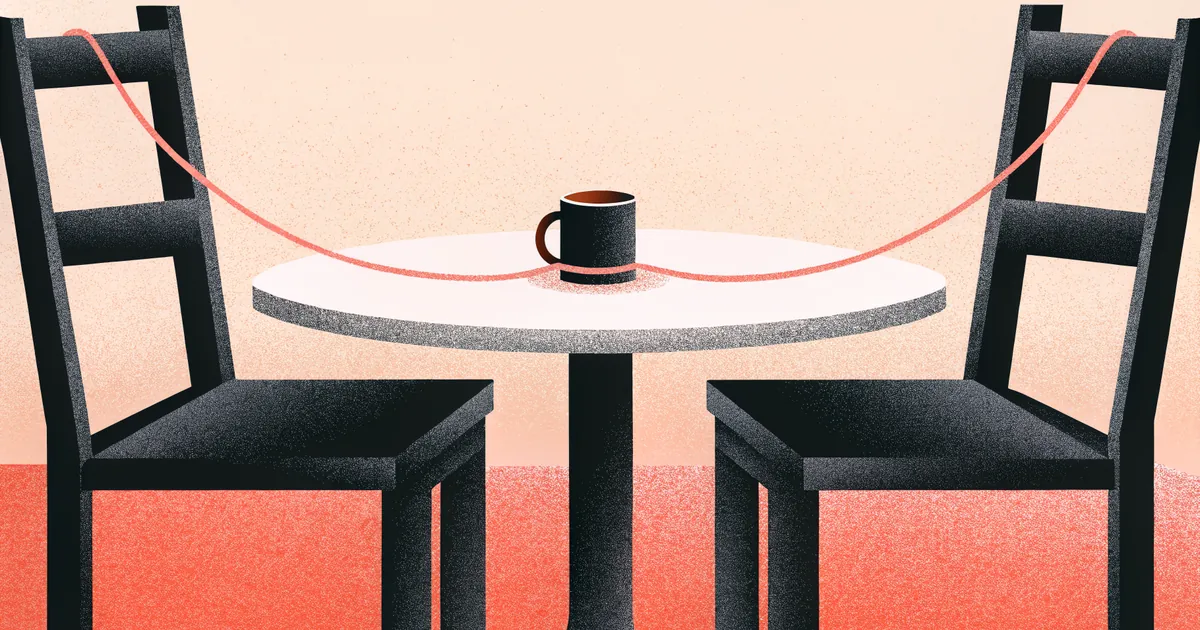
Your Brain Is Wrong About Strangers
You think strangers don’t want to talk to you. You’re wrong.
In 2014, behavioral scientists Nicholas Epley and Juliana Schroeder ran a series of experiments on Chicago commuter trains. They split participants into three groups: one instructed to start a conversation with a stranger, one told to enjoy their solitude, and a control group given no instructions at all. Before boarding, every participant predicted how their commute would go.
The predictions were consistent. People in the conversation group expected an awkward, unpleasant ride. Most assumed the stranger sitting next to them would rather be left alone. When asked to estimate the odds of being rebuffed, participants put it above 50%.
Here’s what actually happened: the conversation group reported the most positive commute of all three conditions. Not by a small margin — by a significant one. And the predicted rebuff rate of 50%+? The actual rebuff rate across all participants instructed to talk was zero percent. Not one person was turned away.
This wasn’t a fluke. Epley and Schroeder replicated the finding across nine experiments in both field and laboratory settings. Every time, the same pattern held: people predicted solitude would feel better, and every time, connection won.
The thesis is simple and uncomfortable. We are systematically miscalibrated about social risk. Our brains treat a conversation with a stranger as a threat when it’s actually a reward. And a decade of research from multiple labs, multiple countries, and multiple methodologies all point to the same conclusion.
The Prediction Error: Why We Choose Solitude
So why does the miscalibration persist? If talking to strangers reliably feels good, why haven’t we updated our expectations?
Epley’s answer is structural. The error survives because we never test it.
“We only learn from the things we do, not from the things we don’t do. Beliefs that are avoidance-oriented are likely to be the most miscalibrated because we don’t learn from experiences we don’t have.” — Nicholas Epley, University of Chicago Booth School of Business
This is the asymmetry at the center of the research. Every time you put in your earbuds instead of saying hello, you collect zero data. Your assumption — they don’t want to talk — goes unchallenged. The belief calcifies not because it’s accurate but because you never run the experiment.
Across all nine of Epley and Schroeder’s experiments, the gap between predicted and actual experience remained wide. Participants in labs showed it. Commuters on trains showed it. People in waiting rooms showed it. The context changed; the miscalibration didn’t.
Your brain isn’t protecting you from a hostile social environment. It’s protecting you from a fictional one.
What Actually Happens When You Talk to a Stranger
If the prediction error is the disease, the wellbeing data is the case for treatment.
Gillian Sandstrom, a psychologist at the University of Sussex, ran a six-day study with over 50 participants tracking their daily conversations and mood. The finding was direct: on days when people had more conversations with strangers and acquaintances — what social scientists call “weak ties” — they were measurably happier.
Not happier in a vague, self-reported-satisfaction way. Happier on validated daily wellbeing scales, with a statistically significant correlation between the number of weak-tie interactions and that day’s happiness score.
A separate experiment tested something even more minimal. Researchers had participants either order coffee from a barista with a brief personal exchange — a smile, a comment, eye contact — or conduct a purely efficient transaction. The group that connected, even for fifteen seconds, reported significantly higher feelings of belonging and wellbeing afterward.
“Even the most casual contacts with strangers and acquaintances can be tremendously beneficial to our mental health.” — Gillian Sandstrom, University of Sussex
A Harvard Business School study extended this further, finding that happiness doesn’t just correlate with how many conversations you have — it correlates with the diversity of relationship types. Talking to your partner is good. Talking to your partner, your coworker, and the person behind you in line is better.
The Effect Holds Everywhere
A fair objection: maybe this is a Western, educated, industrialized phenomenon. Maybe Americans on commuter trains are uniquely starved for small talk.
The data says otherwise. Replications of Epley and Schroeder’s core finding have been conducted across six countries. The prediction error — overestimating social risk, underestimating social reward — appears cross-culturally. This isn’t a quirk of Chicago transit riders. It’s a feature of human cognition.
Neuroimaging research adds another layer. Unscripted social exchange — the kind that happens when you actually talk to someone rather than scroll past them — activates reward circuitry in ways that passive digital consumption does not. Your brain treats a real conversation as fundamentally different from reading a comment thread. The trend toward phone-free bars and restaurants may be an intuitive cultural response to this same finding: remove the default escape hatch, and people connect.
A Week Is All It Takes
The most actionable finding in this body of research comes from a week-long intervention study published in the Journal of Experimental Social Psychology. Participants were assigned to initiate conversations with strangers every day for seven days.
By day seven, they reported lower anticipated rejection, higher conversational self-efficacy, and less social awkwardness than on day one. The prediction error didn’t vanish, but it shrank — measurably and consistently.
A three-week version of the same approach produced an even more surprising result: participants showed meaningful increases in intellectual humility. They became more open to people with different viewpoints. Talking to strangers didn’t just make them feel better — it made them think better.
This is the compounding mechanism. Each positive interaction recalibrates the forecast. The second conversation is easier than the first. The fifth is easier than the second. The bias that kept you isolated weakens every time you test it. It’s the same recalibration impulse behind the dumbphone movement — strip away the digital buffer, and your baseline social confidence rebuilds.
The Nudge Problem — and Who’s Solving It
Here’s the catch. Left to their defaults, people choose solitude. The research is unambiguous on this point. The wellbeing benefits are real, but so is the avoidance bias. People need a prompt.
In Epley’s experiments, that prompt was an instruction card from a researcher. Participants didn’t spontaneously start talking — they were told to. And once told, they discovered the experience was far better than expected. The nudge didn’t create the positive outcome. It just removed the barrier to discovering it.
In the real world, that nudge can be a designed environment. GoOnlife works on the same principle: checking in at a venue signals social openness — converting passive proximity into active connection, the same mechanism that made the train experiments work. The researchers used an instruction card. The app uses a check-in. Both solve the same problem: giving people a reason to override the default.
“It’s the emotional quality of these interactions that matters. When two people share a sense of uplift, mutual warmth, and care, even in a brief moment, those moments accumulate into meaningful psychological benefits.” — Greater Good Science Center, UC Berkeley
You can see this logic running through GoOnlife’s daily progress updates and the broader platform design — each feature is a version of that instruction card, embedded in the places where people already are.
The Real Cost of Not Talking
A 2025 AARP survey found that 40% of U.S. adults report being lonely — up from 35% in both 2010 and 2018. That’s not a gradual drift. That’s an acceleration.
But framing this as a crisis of isolation misses the mechanism. Most lonely people aren’t physically alone. They’re in coffee shops, on trains, in waiting rooms — surrounded by other people making the same miscalculated choice to stay silent. This is a crisis of avoidance, not absence.
“People out in their daily lives aren’t social enough for their own well-being. They don’t engage in conversations with strangers nearly as much as they ought to to maximize their own well-being.” — Nicholas Epley (2025)
The barrier to connection isn’t other people’s coldness. It’s your own forecast — and the forecast is wrong. Every study in this body of research confirms the same thing: the conversation you’re avoiding is almost certainly better than you think.
The researchers gave their participants a simple instruction: talk to someone. That’s the whole intervention. The rest takes care of itself.